
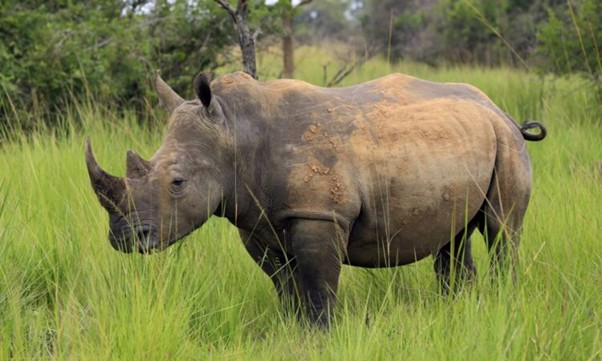
In 2025, the Uganda Wildlife Authority plans to reintroduce the southern white rhinoceros to the Ajai Wildlife Reserve situated in Madi Okollo district northwestern Uganda. This is expected to restore the ecological equilibrium and preserve most wildlife in this reserve. This initiative is inspired by the achievement of the relocation of 200 kobs and 50 buffalos from Kabwoya Wildlife Reserve and Murchison Falls National Park to Ajai Wildlife Reserve.
This reintroduction of southern white rhinos to Ajai Wildlife Reserve has also been a time-honored demand for the people of West Nile. This is because it has a significant potential to attract tourists. This will lead to the growth and development of tourism in the region. Nevertheless, the Uganda Wildlife Authority is still conducting Environmental Impact Assessments while establishing a closure fence for the white rhinos within Ajai Wildlife Reserve.
The Uganda Wildlife Authority is also doing habitat manipulation, an activity that involves clearing the bushes within the Ajai Wildlife Reserve. This is essential since white rhinos prefer to feed on short pastures. This will be followed by an introduction of mammals such as zebras, kobs, buffalos, and others. This will enhance the site’s wildlife diversity for tourists and then the white rhinos from Ziwa Rhino Sanctuary in Nakasongola district will follow.
At the moment, the Ziwa Rhino Sanctuary has 35 white rhinos which have been introduced by the Uganda government since 2005. The Ziwa Rhino Sanctuary was established to primarily reintroduce rhinos into their natural habitat after they had been extinct for over 20 years due to aggressive poaching. However, the Ziwa Rhino Sanctuary will still be maintained as a breeding space while surplus rhinos are relocated to Ajai Wildlife Reserve.
About Ajai Wildlife Reserve
Ajai Wildlife Reserve was established in 1962 as the White Rhino Sanctuary and later on in 1965 as Ajai Game Reserve. Ajai Wildlife Reserve is situated on the west bank of the Nile River between Pakwach district and Nimule City in South Sudan. Ajai covers a total land area of 148 square kilometers and sits on elevations ranging from 700 meters to 1,000 meters above sea level. The Reserve is approximately 390 kilometers from Kampala, the capital city of Uganda.
Ajai Wildlife Reserve has a variety of physical features that comprise rivers, swamps, savannah grassland, and woodland. The wooded savannah and grasslands are composed of loudetia-eragrostis and hyparrhenia species. The older eastern sector has a mosaic of savannah forest and lovely sandy plains, areas of dense forest, rainforest, and open grasses covered by predominantly imperata species. The western sector of Ajai Wildlife Reserve is comprised of predominantly elephant grass, and Pennisetum, with clumps of wild date, plum, and others.
The fauna in Ajai Wildlife Reserve is dominated by mammals that migrate onto the Island during the dry season at a time when there is a lack of forage in the surrounding dry scrubland. The mammal species include hippos, amphibians such as frogs and toads, Uganda kob, hartebeest, bushbuck, waterbuck, black and white colobus monkeys, and olive baboons among others.
Ajai Wildlife Reserve experiences a tropical type of climate characterized by distinct dry and wet seasons. The latter occurs from the months of March to May and from September to November and causes increased rainfall and occasional thunderstorms. The dry season occurs from December to February and June to August. This is characterized by crystal clear blue skies and minimal rainfall quantities, thus creating favorable conditions for outdoor activities.
Regarding the annual rainfall, Ajai Wildlife Reserve receives around 1,000-1,200 millimeters with the majority occurring during the wet season. These rains are crucial for the sustenance of the Reserve’s ecosystems, replenishing its water sources and fostering the growth of dense vegetation. These provide shelter for the resident fauna populations. This makes it quite challenging to encounter the wildlife since they are covered by dense vegetation. They also have surplus sources of water and thus do not move far away in search of water.
The average annual temperature experienced at Ajai Wildlife Reserve ranges from around 25oC to 30oC with differences depending on the particular season. Temperatures are typically relatively warmer and more stable during the dry seasons thus causing comfortable conditions for outdoor activities.
About White Rhinos in Uganda
White rhinos are majestic and iconic mammals that possess several key characteristics. They are also known as Ceratotherium simum and characterized by their enormous size with the adults weighing up to 2.5 tons, making them one of the largest land mammals.
White rhinos are herbivores and their primary food is grass and other vegetation found in the savannah and grassland habitats of Uganda. They have square-shaped lips which are adapted for grazing on low-lying vegetation.
White rhinos are social and often live in small groups known as crashes, comprised of females and their offspring and dominant males defending their territories. They exhibit calm and docile behavior which makes them seem gentle.
They are resilient and adaptable but are threatened by numerous issues such as poaching and habitat loss which even caused their local extinction in Uganda. This has led to the current efforts to reintroduce them into the wild.